From September 2025, AI education is mandatory for every student in China: first grade through university, at least eight hours a year. By the end of last year, AI adoption across Beijing's schools had hit 87.7%.
They're not teaching kids to code. They're teaching them to think with AI: use a model to solve a problem, then question whether the answer is even right. China is spending close to US$27 billion on AI this year. That's not a tech policy. That's a whole population moved onto the same starting line.
In Hong Kong, the best tools are an obstacle course
Now look at Hong Kong, where getting the best AI tools is an obstacle course. Most people don't realise how many walls there are.
Wall 1: the geo-block
OpenAI hasn't granted Hong Kong access since May 2023, citing privacy. ChatGPT, the API, all of it. Hong Kong sits on the “not supported” list, same as the mainland. Claude is blocked too. Gemini opened to Hong Kong in March 2026, with no VPN.
Wall 2: the payment rail
“Just use a VPN.” A VPN gets you to the login screen. It does not get you through checkout. The payment processor reads a card's issuing region straight from the card number. It's baked into the digits, so no VPN or foreign address can fake it. HSBC, Hang Seng and Bank of China (HK) cards get declined at the final step. Reported failure rates for Hong Kong cards run around 60%.
Wall 3: the bank
On the rare occasion the processor is bypassed, the issuing bank blocks the charge anyway.
A ban isn't a wall. It's friction. And friction doesn't stop the determined few. It stops the many.
The engineer with a VPN and a foreign card gets through. The shop owner who'd benefit most never starts.
But the wall was never the real problem
Here's the part that proves it isn't really about the block at all.
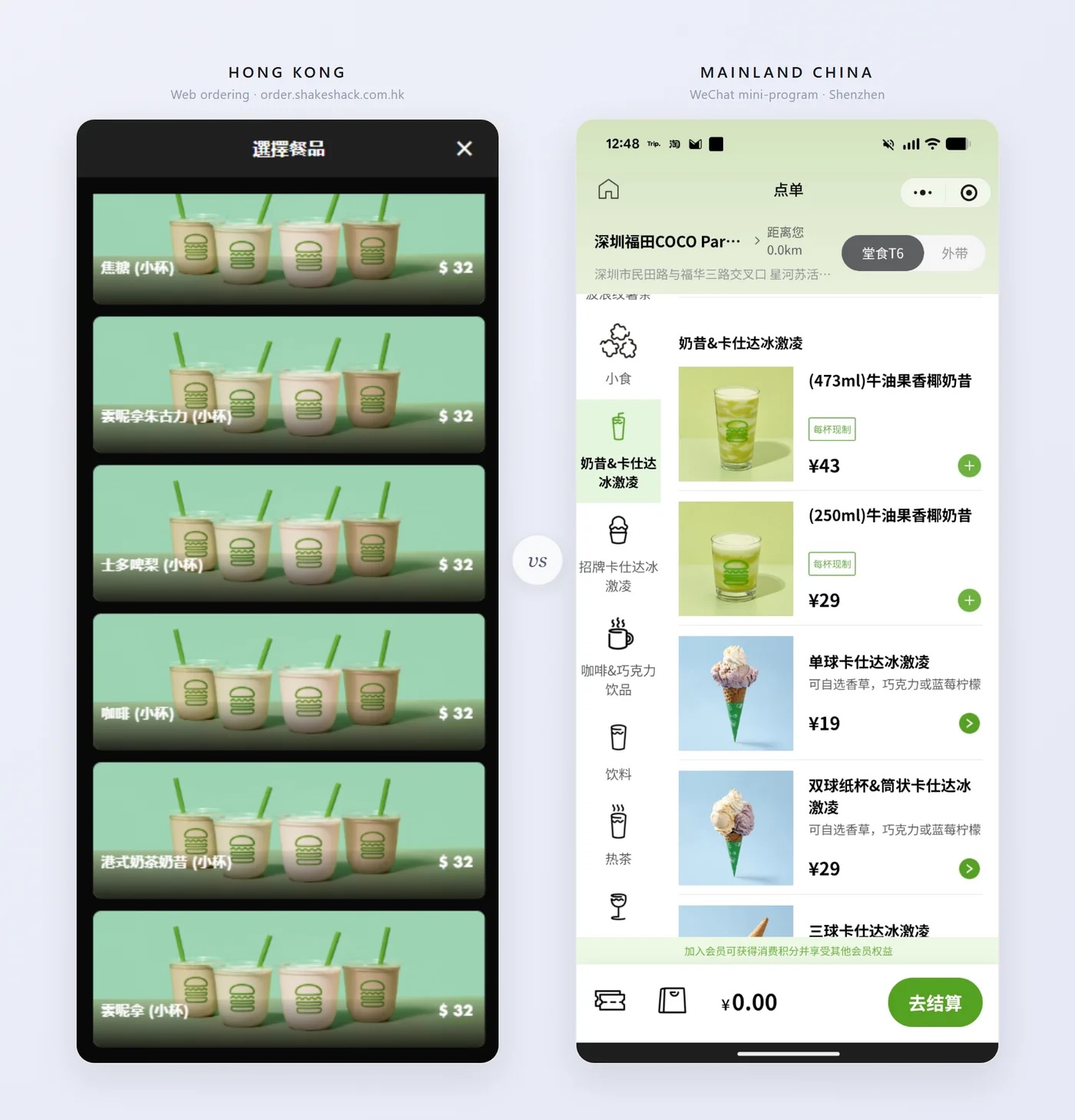
Look at the image. Same brand, same ordering screen, side by side: Hong Kong on the left, mainland China on the right. Take the Hong Kong-style shake. The same drink sits in three places on one menu, and no two agree. The listing with a real photo won't tell you the size. The other two make you choose a cup size before a flavour. Once you do, every flavour wears the identical stock photo of empty cups. Caramel, cookies-and-cream, strawberry, coffee: you genuinely cannot tell them apart, for a $32 drink.
On the right, mainland China: every shake shot fresh and made to order, its own photo, table-side QR ordering, a clean checkout, a full anniversary campaign.
Same brand. Same burgers. The mainland, behind the Great Firewall, with less access to Western tools, ships the better product. So the wall was never the real problem.
Good enough is a decision
The real problem is that Hong Kong tolerates the version on the left. When “good enough” is accepted, “good enough” is what gets built.
Don't take our word for it. Open the Hong Kong ordering site and scroll the shakes. It's on the open web. You'll see it in five seconds. (The mainland version lives inside a WeChat mini-program, which is exactly why it's shown in screenshots above.)
The states that survived adopted fastest
This isn't new. About 2,300 years ago, in the Warring States period, the states that survived weren't the ones with the proudest traditions. They were the ones that adopted fastest.
Qin didn't win by inventing. County administration and private land ownership had existed for two centuries. Shang Yang just stopped debating and implemented. His line to the traditionalists has aged well:
There is no single way to govern, and you do not strengthen a state by copying the past.
Shang Yang
The cautionary tale is Duke Xiang of Song, who insisted on fighting by the honourable old rules. He refused to strike the enemy mid-river. He refused again while they were disorganised, because it wasn't proper. He waited for the noble moment; they formed up, destroyed his army, and he died of the wound. History remembers him as the man who followed the rulebook into his grave.
Made in Hong Kong
Moofa is made in Hong Kong. When Mixue, the world's largest tea chain, needed an ordering and delivery system here, no local platform could draw delivery zones to real streets instead of lazy circles. So we built the whole thing from scratch. Live in six weeks.
The talent exists. The capability exists. Our entire premise is one line: if it can be automated, manual is a choice. The tools are sitting right there. Not using them is a decision. In a moment like this, it's the Duke Xiang decision.
Hong Kong: if you've hit one of these walls, the VPN, the declined card, the “why is this so hard”, tell us below. And honestly: are we behind because of the block? Or were we always going to accept good enough?
We build custom ordering systems, delivery platforms and internal tools for businesses when off-the-shelf software doesn't fit. These are notes from the field.
Reply
Tell us what you think